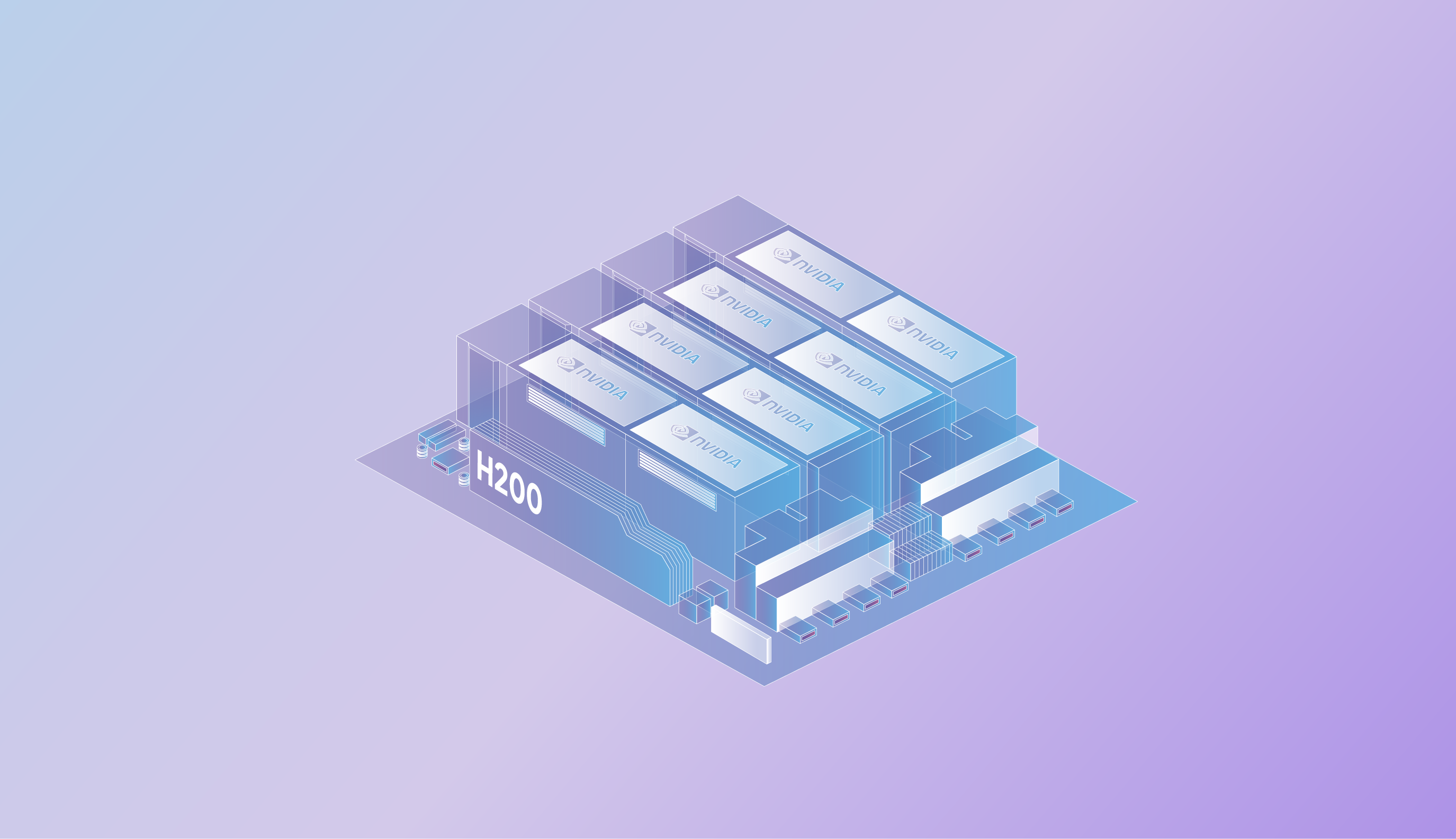
Why NVIDIA H200 SXM Matters for Modern AI Workloads

Updated on
Published on
By

Table of Content
The scale of open source AI workloads has changed dramatically within a short period of time. Models that once required careful optimization to run on limited infrastructure are now handling multimodal reasoning, long-context processing, and continuous inference across production environments. Enterprises are integrating these systems into internal operations, customer-facing platforms, analytics pipelines, and developer tooling with increasing frequency.
This shift has placed new pressure on infrastructure decisions. GPU selection now affects far more than raw training speed. Memory bandwidth, orchestration efficiency, context handling, and sustained workload performance have become operational considerations for teams building serious AI systems.
The NVIDIA H200 SXM has entered this landscape at a point where infrastructure requirements are evolving alongside the models themselves. Open-source ecosystems are becoming larger, more memory-intensive, and increasingly persistent after deployment. Systems no longer remain static once they go live. They continue adapting through fine-tuning, retrieval augmentation, and ongoing optimization cycles.
Under these conditions, infrastructure starts behaving less like a support layer and more like a foundational capability within the AI stack.
One of the more interesting developments in AI over the last few years has been how quickly open source models have closed the capability gap across multiple domains. Language reasoning, image generation, coding assistance, and multimodal interactions are no longer limited to highly restricted environments.
As these models become more capable, deployment expectations also expand. Teams are no longer running isolated demos or small experimental workloads. They are building production systems expected to process large volumes of requests with consistency and responsiveness.
This introduces a challenge that many organizations discover only after scaling begins.
Infrastructure assumptions that worked during experimentation often become restrictive under production conditions. Smaller GPU environments can struggle with:
The issue is rarely a single bottleneck. It is usually the cumulative pressure created by memory utilization, throughput demands, and operational continuity occurring simultaneously.
This is where GPUs like the NVIDIA H200 SXM become relevant. They support workloads that are no longer operating at the edge of experimentation but have moved firmly into operational scale.
There has been a noticeable shift in how organizations approach AI infrastructure. Earlier workflows often treated GPUs as isolated compute resources provisioned for specific tasks. Current environments behave more like operational ecosystems where training, inference, monitoring, orchestration, and scaling all interact continuously.
Managed GPU infrastructure has emerged as a practical response to this complexity.
The value of managed environments comes from reducing the operational overhead surrounding large-scale AI systems. Engineering teams no longer need to spend disproportionate time configuring distributed workloads, monitoring infrastructure health, or manually scaling deployment environments. Those capabilities increasingly exist within the platform layer itself.
In practice, teams stabilize production by standardizing serving as AI inference as a service instead of rebuilding deployment patterns for every new workload.
This changes how AI systems are developed and maintained.
A managed GPU environment behaves somewhat like a modern container port. Cargo still matters, but the surrounding logistics system determines how efficiently everything moves. Scheduling, orchestration, visibility, and operational coordination influence overall throughput as much as the hardware itself.
AI cloud platforms such as Neysa are designed around this operational model. Managed VM environments combine GPU infrastructure with orchestration and deployment tooling that supports long-running AI workloads across multiple stages of development and production.
As open source systems become more sophisticated, this level of operational structure becomes increasingly important.
The NVIDIA H200 SXM sits at the high end of AI compute environments designed for large-scale workloads that demand significant memory capacity and throughput efficiency. Its positioning reflects how modern AI systems are evolving rather than simply extending raw compute performance.
Large language models are growing in parameter size and context handling requirements. Retrieval augmented systems continuously process external data sources during inference. Multimodal models combine text, image, audio, and video inputs within unified workflows. These workloads create sustained pressure on memory bandwidth and GPU interconnect performance.
The H200 SXM addresses these conditions through increased memory capacity and architecture optimized for large-scale AI operations. This becomes particularly valuable for organizations handling:
What makes the H200 SXM operationally significant is its ability to support increasingly complex workloads without forcing constant compromises around context limits, model partitioning, or workload fragmentation.
This has practical implications for open source AI teams.
Larger memory environments allow models to operate more naturally within production systems. Teams can process richer contexts, maintain more capable inference pipelines, and iterate on larger architectures without restructuring infrastructure around hardware constraints.
The result is not simply faster compute. It is greater operational flexibility across the lifecycle of the AI system.
Memory capacity has become one of the defining constraints within modern AI workloads. As context windows expand and models process increasingly sophisticated inputs, memory architecture directly influences what systems can realistically handle in production.
This is particularly evident in open-source AI ecosystems, where experimentation moves rapidly. Teams regularly modify architectures, combine retrieval systems with reasoning models, and adapt multimodal pipelines for highly specialized tasks.
Each of these additions increases operational complexity.
The H200 SXM supports this evolution because its architecture is designed around workloads where large-scale memory handling becomes central to performance. This matters not only during training but also during inference, where responsiveness and context continuity increasingly shape user experience.
Managed AI cloud infrastructure amplifies these advantages by providing environments where high-memory GPU systems can operate within coordinated deployment workflows.
Neysa’s managed GPU environments support these operational patterns by enabling teams to provision H200 SXM workloads within infrastructure already structured for orchestration, monitoring, and scalable AI operations. This reduces infrastructure management overhead while allowing workloads to evolve continuously after deployment.
The trajectory of open source AI suggests that systems will continue becoming more adaptive, multimodal, and operationally persistent over time. Models are no longer deployed once and left unchanged. They are retrained, updated, fine tuned, and connected to live data systems continuously.
Infrastructure therefore, needs to support ongoing adaptation rather than isolated compute bursts.
The NVIDIA H200 SXM represents this stage of infrastructure evolution. It supports environments where workloads are large, memory intensive, and operationally continuous. This aligns closely with how advanced open source AI systems are beginning to behave across enterprise and research environments.
Managed AI cloud platforms will likely continue becoming more important as these workloads expand because operational coordination now influences AI system performance as much as raw compute capability.
This changes how organizations evaluate infrastructure itself.
The conversation is gradually shifting from isolated hardware benchmarks toward operational sustainability across the full lifecycle of AI deployment.
Build and scale your next real-world impact AI application with Neysa today.
Share this article:


AI teams move faster when the tools around them do not slow them down. Neysa’s AI Platform-as-a-Service provides a cloud native stack that simplifies training, orchestration, deployment, and monitoring, helping organisations scale their AI programmes with confidence.

Back to Blog Home Table of Content Remember the Internet? The current conversations surrounding the adoption of (artificial intelligence) AI in business are reminiscent of conversations in the late 20th century. A time when the internet and personal computers (PCs) began to challenge how things had always been done. When people first saw or used […]