If vLLM already solved LLM serving, why did SGLang appear?

Updated on
Published on
By

Table of Content
About the author

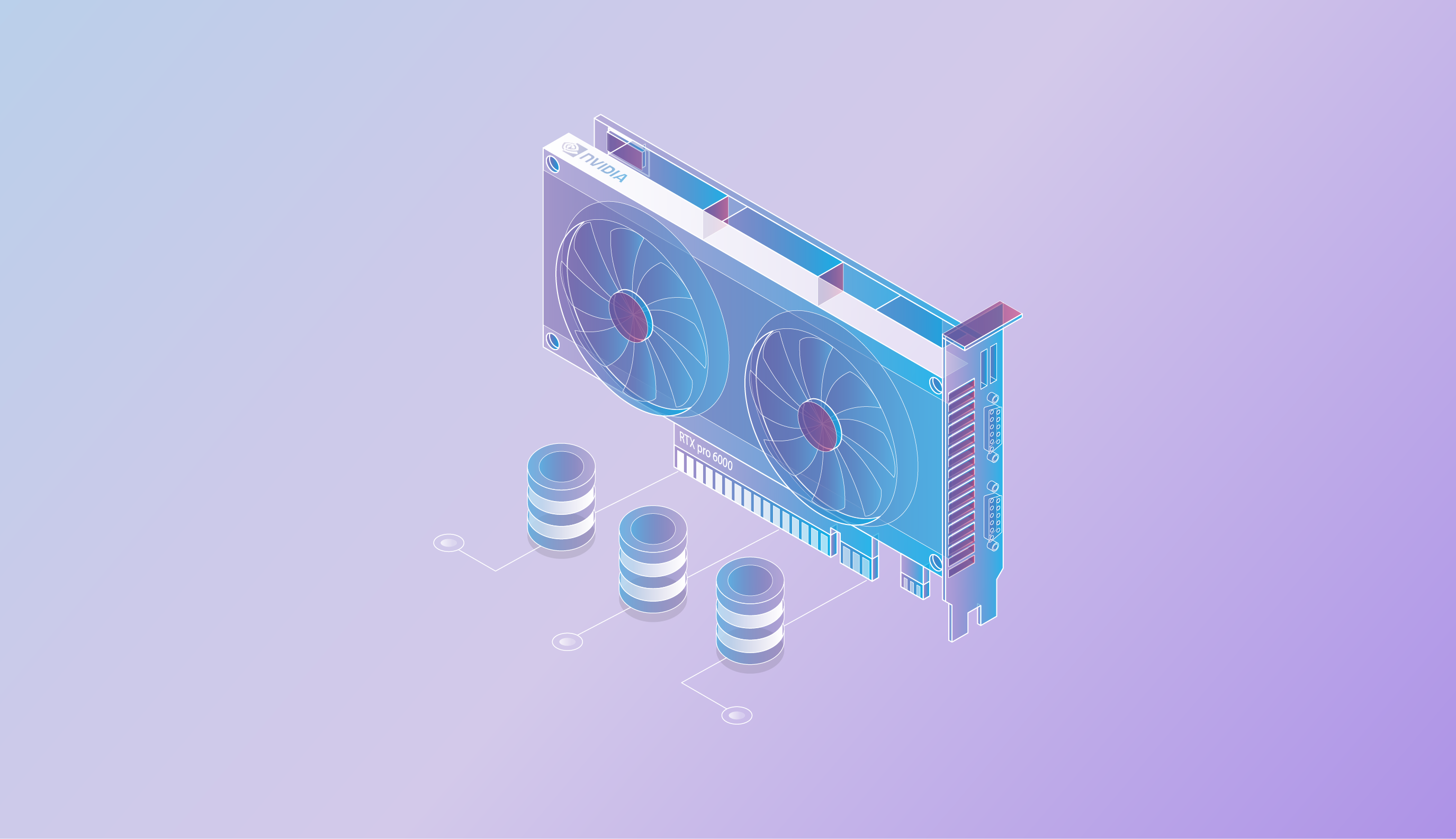
The NVIDIA RTX Pro 6000 is the most powerful professional GPU NVIDIA has ever built.
Announced at GTC 2025 on the Blackwell architecture, it’s designed for the layer of AI work that
happens before anything goes to data center scale – development, fine-tuning, simulation, and
experimentation on workstations and smaller servers. One number defines it more than
anything else: 96GB of GDDR7 memory, double of what the previous generation RTX 6000 Ada
carried.
The RTX Pro 6000 comes in three versions, each for a different deployment context:
Power draw and thermal design are the only real differences between
them.
At 1.8 TB/s of memory bandwidth, the RTX Pro 6000 doesn’t just hold more – it moves data
through faster than its predecessor too.
Here’s what 96GB changes in practice:
The honest version of this is that 96GB doesn’t make the RTX Pro 6000 better at the same jobs
the Ada did. It makes a different set of jobs possible.
Unlock next-generation GPU performance for demanding AI workloads with Blackwell-powered infrastructure.

The RTX Pro 6000 is a multi-workload card by design, built for professionals who need to move
across disciplines rather than stay in one lane:
It’s worth being clear about what it’s not for: large-scale distributed training across clusters.
That’s H100 SXM or H200 SXM territory. The RTX Pro 6000 is where the work happens before
you need that.
| RTX Pro 6000 | H100 SXM | L40S | |
| Primary Role | Local AI development, fine-tuning, inference testing, simulation | Large-scale distributed training at data center scale | Inference and rendering in server deployments |
| Memory | 96GB GDDR7 1.8 TB/s bandwidth | 80GB HBM3 3.35 TB/s bandwidth | 48GB GDDR6 864 GB/s bandwidth |
| Architecture | Blackwell PCIe Gen 5 | Hopper NVLink 4.0 | Ada Lovelace PCIe Gen 4 |
| Where it runs | Workstations and standard rack servers (3 variants) | Data center clusters only, NVLink required for multi-GPU | Standard 2U rack servers |
| AI Performance | 4,000 TOPS | 3,958 TOPS | 1,457 TOPS |
The RTX Pro 6000 isn’t competing with the H100 SXM or H200 SXM for large-scale distributed
training. That’s a different stage of the workflow – one that needs NVLink interconnects, HBM3
memory, and data center infrastructure built around it.
The RTX Pro 6000 is designed for local development, fast experimentation, fine-tuning without the cost of cloud compute at every iteration. When teams are ready to scale, they move to H100 or H200 infrastructure. The two aren’t in competition – they’re sequential.
For teams currently on L40S hardware, the Server Edition is the natural upgrade path.
Same server form factor, more than double the memory, and a full architecture generation ahead.
The previous RTX 6000 Ada was widely used for professional AI workloads. RTX Pro 6000
Blackwell doesn’t change what it’s used for – it changes how much you can do before hitting the
ceiling.
The RTX Pro 6000 Blackwell is coming to Neysa Velocis. If your team is working out which GPU
fits where in your AI pipeline – get in touch with the team to get on the early access list.
Deploy, run, train, fine-tune and serve all open-source models. Scale with confidence.

Back to Blog Home Table of Content Introduction – Enterprise GPU Cloud Platforms Modern AI systems depend on compute. The models behind personalization, diagnostics, automation, and generative tasks do not succeed because of clever code. They succeed because the infrastructure delivers reliable, predictable GPU capacity at scale. Early experiments with GPUs are often simple – […]

Voice AI, more than most AI applications, exposes the gap between what looks impressive and what actually works at scale.
This blog explores from our conversation with Akshat Mandloi – CTO & Co-Founder of Smallest.ai